
I used to think of branding as a necessary evil, and then as a tool, and a process, and finally: I’m starting to think of it as a fine wine.
To some degree, perhaps it’s all of the above. But let’s talk for moment about how, beyond a marketing aspect, branding can become a delight: something refined, and welcoming, and all but ready to crack open and share. A party favor the host(ess) may enjoy furnishing as much as visiting guests, including target audience, may rejoice to find on offer.
As others have said: A creative professional doesn’t need a tagline for their work – but they can absolutely benefit from having one. A tagline may be conjured at any stage in your career, beginner or veteran. You can employ it loudly in social bios and on your business cards, or keep it just to yourself. But whether you treat it as a personal tool or a professional one, writing a tagline is an exercise in intent: telling others, or yourself, the kind of work that you want to be known for. This is a chance to define your own style — or goal — and to make an impression that may drive business.
What is an author/artist/creative professional tagline?
A tagline is a bite-sized phrase that should both inform…and perform. That is, it should objectively describe the kind of work you do while also invoking something of that work in your own style – whose purpose may be to entertain, or comfort, or create a certain atmosphere (or none, or all of the above). A successful tagline therefore might make you laugh, or sit up straighter, or say “Ooh” and investigate further. It might give you food for thought, or pause to relish it.
In any case, a tagline should be authentic, original, and unique. It should honestly reflect what you’re advertising, and give strangers a reason to give your work a chance.
What should it include (examples, please)?
Your tagline should include industry/classification language people will easily understand, and your own signature flavor.
Some author tagline examples:
“Seatbelt suspense.” I looove this tagline from author Brandilyn Collins, which I first read here. It tells you exactly what kind of stories Collins writes (“suspense” = thrillers), and engages with a concrete image/sensation – all in an appropriately fast-paced couple words. The phrase is so well-designed, it made me look up more about her and her books, which is exactly what a good tagline should do.
“Three-wick drama.” After much brainstorming, this was the tagline I was happy with for my own books. “Drama” reflects that I write contemporary stories about the human experience; “three-wick” evokes a luxury candle, suggesting slow-burn, inhabitable warmth, and the complexity of multiple threads/subplots. A candle also cracks open the door to supernatural elements, leaving my novels the desired room grow in that direction.
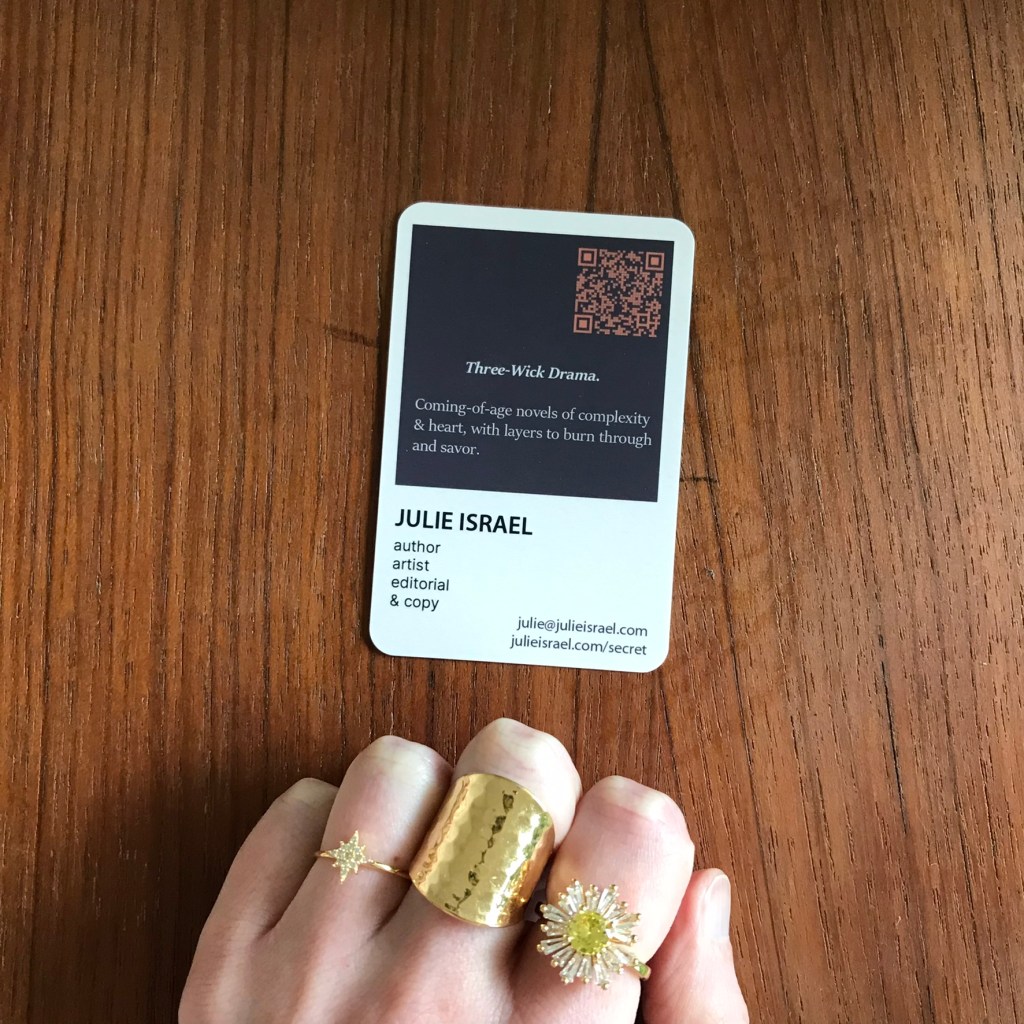
One caveat, however, is that “three-wick” implies, but does not expressly say “candle.” Which means that if someone doesn’t make the connection, the meaning could be lost. On my business card then, I add a little more: coming-of-age novels of complexity and heart, with layers to burn through and savor. This elaborates, while allowing the headline to remain crisp. Also, I figure it’s easy enough to say “like a good candle — stories to sink into” in the time it takes to hand someone my business card.
Bottom line: some ambiguous language can work, but use with care.
Artist taglines
For comparison, I’ve rounded up the bios of a few well-established artists I follow on Instagram:
“Illustrator | Designer | Pattern-creator / specializing in flowers & bright colors.” @jessraephoenix
“Illustrator & surface designer specializing in bold florals, quirky animals, and mood boosting color palettes.” @taranormal
“PAPER & GOODS / For plant addicts, nature & travel lovers” @allthewaystosay
Of the dozen-ish full-time artist bios I sampled, they pretty much all read like this: a little longer – and less snappy – but also more specific, and likely to include 2-3 repeat themes that help characterize their style and/or target audience.
Perhaps because artists rely more on their visuals to make an impression, their taglines need not be as concise or memorable. But notably, they follow the same rules, spelling out exactly what an audience can expect in their work.
What should a tagline include?
The pattern I observe is [big picture] + [detail(s) unique to your style]. That is, start in broad terms with your field/specialty—“illustrator” “surface designer” “paper & goods” “suspense” “drama”—and then tell people what makes your work in that field yours. When you’re finished, a stranger should have a clear idea of what you make, write, etc.
What should it not include?
Unclear or ambiguous language. Redundant wording or information.
When spitballing, one option I’d come up with was “first place,” coming-of-age stories. I threw it out because “first place” could be read as a first-place ribbon or trophy, and not the “first apartment,” rite-of-passage, inhabitable warmth element I was going for. Moreover, instead of clarifying, “coming-of-age” was then repetitive of that note.
How do I create a tagline?
You can draw from reader emails (as Collins did) or comments on your art, looking for language repeatedly used to describe your work. You could create a list or mind map of notes you want to hit, then brainstorm phrases, images, etc. with which to summon that. If your body of work is too slim to spot recurring themes, think about the kind of work you want to be known for, and use that as your guide.
Spend some time with it (personally, it took me about a week of thought & brainstorming sessions). Come up with three, or five, or ten options, and perhaps test them on other people. One is likely to pull to the top.
What if my “brand” is mixed genres / eclectic?
Hello! It me. I once resisted branding for this very reason. My debut novel was contemporary YA, and mystery-driven. But what if, down the line, I wanted to write fantasy or dystopian or stories with a supernatural/speculative element? I didn’t want to pigeon-hole myself.
Well, I’ve written enough by now to see patterns in my work. Rather than name a genre, I first looked to those themes: stories that make people both laugh and cry; warmth; multiple threads. Lovable characters, and spaces you want to inhabit a while (and perhaps revisit).
It was coming from this angle that helped me settle on “drama”—a term people will recognize as contemporary stories with characters you can root for, and room for both laughter and tears—and “three-wick,” which hit the remaining notes I wanted. And left space for the supernatural!
So I think the strategy here for eclectics is two-fold: one, be deliberate and take the time to really brainstorm every image, turn-of-phrase, etc. to say the things you want to evoke. Two, choose packhorse language that, while versatile, is easily understood.
What are the benefits of having a tagline?
As noted above, crafting a tagline is an exercise in intent. Taking the time to make one asks you, the creator, to really think on what it is you’re about, and what you’re after. Naming that is powerful in itself (because conscious or subconsciously, naming a goal is a solid step toward reaching it, right?).
But more empirically, a tagline is branding — and good branding observably equates to more sales, followers, eyes on your work, etc. A well-placed tagline can work for you, passively winning new fans, interest, engagement — and may add up to something remarkable.
But even if it doesn’t help you go viral or earn out or hit the New York Times bestseller list, it’s something to keep in your back pocket. Now whenever someone asks “What do you [write] [make] [do]?” you’ll have that sweet little sample to hand out.
And remember…
- You’re not limited to your tagline! If you’re a longtime romance author and want your next book to be sci-fi, you can do that. Branding is just a conscious effort to describe your style, and shows that effort has been made. It doesn’t mean you can’t evolve or experiment, or even go a new direction in your work and update your tagline later.
- You don’t need a tagline. So don’t sweat creating or perfecting one. But do consider its usefulness as a tool whether for yourself, your audience, or both.
- You don’t have to share your tagline. You can use it as a compass just for you.
What taglines—for creatives or not—have made a lasting impression on you?
 Julie Israel
Leave a comment